
In the Philippines, the struggle is all too real: soaring electricity bills, unbearable heat, and brownouts that kill your electric fan exactly when you need it. It’s no wonder homeowners are switching to solar.
But let’s be honest—figuring out how it all works can be a headache. To simplify things, I’ve put together the ultimate guide to solar panel systems, installers, and the essential equipment you’ll need to power your home.
Why Invest in Solar Panels? Let’s Hear the Reviews.
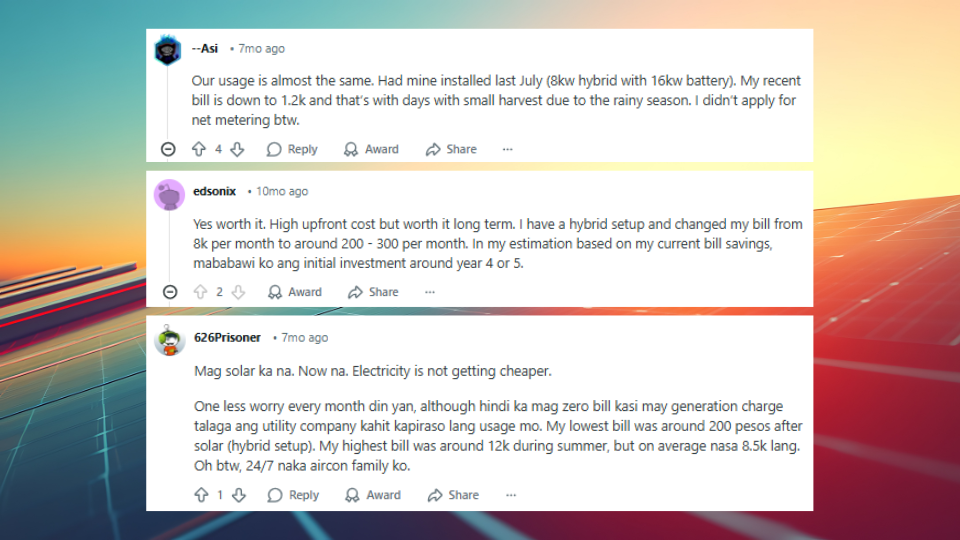
Investing in solar is no longer just about being “green,” it’s also about financial defense. And that’s what people on Reddit are vouching for—reduced monthly expenses, return of investment, and consumption with lesser guilt.
Understanding Solar Panel Systems: Choosing Which Works Best For You
If you’re already convinced, one of the next important decisions you’ll make is choosing the right system type. The choice usually boils down to how you want to interact with the main power grid. It’s also best to coordinate with your landlords first if you’re leasing or renting so they’ll know how to deal with the previous energy provider.
1. Grid-Tied Systems
This is the most popular choice for those looking to slash their monthly or provincial utility bills. In this setup, your home remains connected to the main power lines.
- How it works: Your panels feed electricity into your home, and any excess power is sent back to the grid.
- The Benefit: Through “Net Metering,” the surplus energy you give back essentially “pays” for the electricity you pull from the grid at night.
- The Challenge: You will still experience power outages during a brownout unless you have solar batteries for backup power.
2. Off-Grid Systems
If you are building in a remote area or want total independence from power companies, an off-grid system is the way to go.
- How it works: Your house runs entirely on a large solar battery bank charged by your solar panels. You have no connection to the utility company.
- The Benefit: You’ll still have electricity even if your neighbors are experiencing a brownout.
- The Challenge: While you’ll never get a power bill again, the initial investment is much higher. The need for extra equipment means your return on investment (ROI) may take longer to achieve.
The bottom line? Whether you go on-grid or off-grid, solar batteries are the common denominator. In the Philippine context—where brownouts are frequent—having a battery ensures you have backup and “free” electricity to keep the lights on and the fans spinning all night long.
Solar Panel Installers
If you’re aiming for hassle-free installment and a home fully powered by solar energy, you may contact these well-established and frequently recommended solar panel installers to inquire:
1. Solaric Corp
- Address: 54 E Rodriguez Pasig , Pasig, Philippines, 1600
- Number: (+63) 917 860 3141
- Facebook page: facebook.com/solaricph
- Website: solaric.com.ph
2. PHILERGY German Solar
- Address: 8F Magnitude Bldg, 186 E. Rodriguez Jr. Ave, Quezon City
- Number: (+63)2 8638 8277
- Facebook page: facebook.com/PhilippineGermanSolar
- Website: philergy.com
3. GoSolar Philippines
- Address: 3rd Floor, SPEC Center, No. 66 Alabang-Zapote Road, Pamplona Uno, Las Piñas, 1740 Metro Manila, Philippines
- Number: (+63) 947 994 6820 / (+63) 917 704 8936
- Facebook page: facebook.com/gosolarphilippines
- Website: gosolarphilippines.com
4. Unisolar Inc.
- Address: Unit 203, No. 71 P. Tuazon St, Cubao, Quezon City
- Number: (+63)2 8725 1453
- Facebook page: facebook.com/unisolar.ph
- Website: unisolar.com.ph
5. Solenergy Systems Inc.
- Address: 172 Salcedo Street, Legaspi Village, Makati, Philippines, 1229
- Number: (+63)2 7624 3861 | (+63) 917 534 1909
- Facebook page: facebook.com/solenergyph
- Website: solenergy.com.ph
6. SuntriSolar
- Address: San Miguel, Batangas City, Philippines, 4234
- Number: (+63) 917 615 9356
- Facebook page: facebook.com/suntritrading
- E-mail: suntrisolar@gmail.com
DIY Solar Panel System at Home
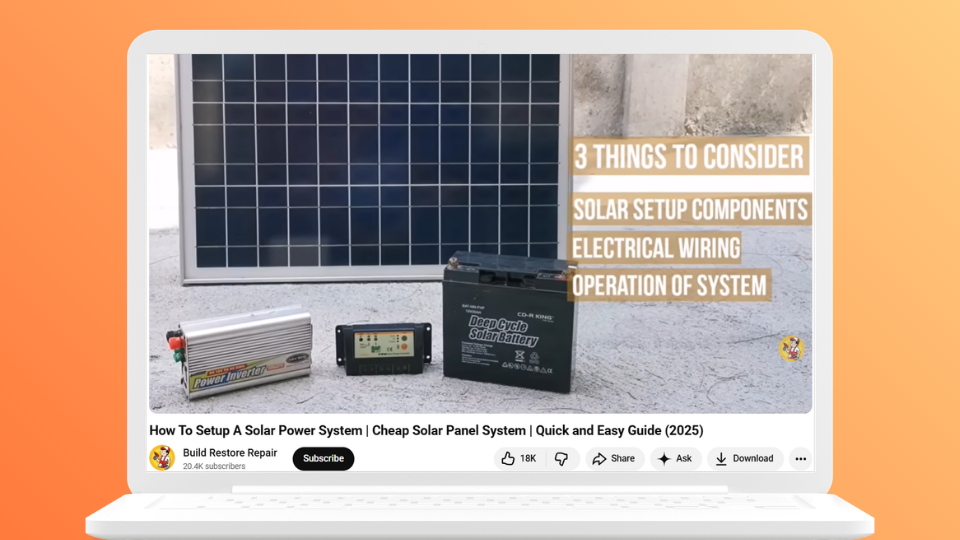
Look, hiring an installer may cost a bit more. So if you just want to test out if solar energy is fit for your home and lifestyle, you may experiment with a DIY solar panel system at home. Build Restore and Repair’s video on YouTube shows the detailed process of installing a cheap off-grid solar panel system you can use at home for basic appliances, phones, and computers.
Materials You Need for Solar Panel At Home
To get started, here are the essential equipment Build Restore and Repair used in their guide:
1. Solar Panel
- Material: 50 Watt Monocrystalline/Polycrystalline (12V)
- Function: Primary power source.
2. Solar Charge Controller
- Material: 30A PWM Solar Charge Controller
- Function: Regulates the voltage from the panel to the battery.
3. Battery
- Material: 12V 7Ah to 12Ah Sealed Lead Acid (SLA) Battery
- Function: Stores the energy for later use.
4. Power Inverter
- Material: 500W DC to AC Power Inverter
- Function: Converts 12V battery power to 220V for appliances.
5. Electric Cables
- Material: High-Quality Electric Wires
- Function: Typically 12-14 AWG for a small setup like this.
6. Connectors
- Material: MC4 Connectors
- Function: Used to securely connect the solar panel wires.
Frequently Asked Questions (FAQs)
What watts of solar panel should I buy?
In recent years, the 500W solar panel is widely considered the best option for residential use. While you can still find smaller 300W or 400W panels, the 500W modules are the current industry standard because they offer the highest efficiency in a manageable size.
Can I run big appliances like aircon or refrigerator with a solar panel?
Yes, definitely—but it’s all about the system sizing. A single 500W solar panel produces enough daily energy to run a modern inverter-style refrigerator while you need 3-4 500W solar panels for an inverter aircon.
What are the disadvantages of solar panels?
While the benefits are significant, the disadvantages of solar panels mainly revolve around high upfront costs and environmental dependencies. These panels also require substantial, unshaded roof space due to their large size and need periodic cleaning to remove dust and debris that can hinder efficiency.
Empower Your Home
Don’t wait for the next power outage to wish you had made the switch. Now that you’ve done the research, it’s time to budget your investment and canvas for equipment.
Make the switch but do it smart! If you’re looking for a more “sulit” way to go solar–I recommend you #CheckShopeeFirst to unlock exclusive deals and free shipping vouchers. You can even unlock flexible payment methods using SPayLater at low to 0% interest so you won’t have to shell out a large amount of savings all at once.